Wednesday, April 15, 2020

Gauging Emotion

Isa - ice / pronounced EE-sa - as created by my talented sister in Zentangle

Friday was my birthday and well, it was a little different this year but that is okay.  Of course, I spent it with my family.  I FaceTimed my sister and we hung out for a good bit of the day and that was nice.  Friends texted and called and I felt really blessed to be surrounded and supported by so many wonderful people.

I asked my son to pull a card for me to give me some guidance when he didn't know what to give me this year.  The card he pulled read, "This is not the time for action.  Be patient and still for now."

To me, this echoed the teachings of the Norse Rune Isa and I feel that "stillness" has been with me for a while now in this quarantine.

For my birthday we watched Frozen II and I highly recommend it.  And idea that is central to that mythos is that water has memory.  

If you have read The Hidden Messages in Water by Masaru Emoto then this is not a new idea.  Dr. Emoto found that beautiful crystals would form in water as it froze when positive thoughts were directed at that water.  After reading this book, I created a positive sticky note that sat under my water with messages of love and support.  

For me, water has always been a symbol of the emotions and anything that can bring in more love and happiness is something worth adding to my routine.  Since to me, water is liquid emotion this whole idea rings true.

So when you freeze all that emotion...you get Isa.  Isa is ice, stillness, inertia, stasis, and serenity...

When we are "frozen" our physical energy can seem low.  We feel like we want to move forward but under our feet, the ice is slippery and makes us move out of control.

I have always had many minds about Isa as you can see in this post.  

In Return of the Jedi, Obi-Wan Kenobi tells Luke Skywalker, "What I told you was true, from a certain point of view.  You're going to find that many of the truths we cling to depend greatly on our own point of view."

When things are frozen you can look at them from a new perspective.  You can see them from all sides and create a whole concept based on more than just seeing one face and basing your information on that one thing.

Isa is the goal of meditation.  Cultivating this stillness helps to build our spiritual muscles so we can go deeper into ourselves.  But staying in this state of stillness outside of our spiritual time can cause an imbalance when the individual no longer wants to be part of or interact with the outside world.

Isa can also calm confusion or hysteria and help to numb pain.  Think of when you put an ice pack on a sore muscle how that numbness brought you relief.  Isa can do this for an overworked mental state as well allowing you a moment to breathe and regroup and find your footing again.

Another face of standstill is a nurturing one.  Like the bear who settles in their cave as winter rages outside, this is a time to go within and restore and renew ourselves so that when Spring comes again we can emerge rested and whole.


Zentangle I made on the computer to demonstrate bridges in an active mind.
Isa also serves as a bridge.  A line is made up of two points and a connection between those points.  This connection forms a bridge between point A and point B.  This line then can be used over and over to create the other runes which vary in diversity and complexity but all of them start from a single line.  All of them start from Isa.

It might be interesting to note if you think of the "bridge" as a string and take one end and affix it down and attach a pen to the other end.  You can now draw a circle using the two points...ta da...now you are practicing sacred geometry or actual geometry...it is all the same really.

This bridge can also be used by your consciousness to move you from one thought to another when you are practicing stillness through meditation or contemplation.   With practice, we can move from point to point across each bridge and watch our mind's process without getting caught up in the distraction of it.

My sister shared something that I want to share with you...ice sings.  As the ice expands or contracts it can cause vibrations that are so strong that you could feel them if you were lying on it and so loud that they can be heard as high and low notes that are hauntingly beautiful.

I always thought that ice was silent but now I know that is not true. 


Right now, I feel frozen, I feel stuck in place and find it hard to focus on anything.  But I know at some point I will thaw.  Inertia and motion are at opposite ends of the spectrum and usually, I fall in the center of them.  One can't stay on one end forever so I know at some point I will have energy and drive again.

But right now I don't.  The cards said it was okay.  Isa said it is okay.  And whatever you are feeling is okay too.  There is no right way to feel right now.  You do you boo.  

🤗 (socially distanced hugs)

************************
Sending love and light to everyone being affected by this virus.  
May you be safe.  
May your loved ones be safe.  
🙏
************************

I am going to say a word...swatch.  How does that make you feel?  😀

For many, swatching is something that brings up feelings of dread or they feel it is totally unnecessary.


So what is swatching?


When you want your fabric to resemble the size and shape of a specific pattern's gauge, you make a sample of what that fabric would look like called a swatch.


Gauge is the number of stitches and rows per inch in your fabric.  Gauge comes out differently for each person even if they are using the exact same needles and yan.  Some knitters knit tighter, some looser and others have an even gauge.


Gauge is formed by three things:
  • The size of the yarn
  • The size of the needles
  • The tension of the knitter (BTW tension can change in stressful situations or moments of calm)
The person that created the pattern you are using could be a tight knitter and her gauge will be totally different than a loose knitter, which is one of the reasons why we need to knit a gauge swatch.

Obtaining gauge allows any knitter; tight, loose or even to all be able to create the same fabric using their way of knitting without having to adapt or change the way they knit. 

So how do you make a gauge swatch?


My gauge swatch with 3 different types of gage measuring tools.  
Of course, you can just use a ruler or tape measure.

The most common way to make a swatch is to knit a four-inch by four-inch stockinette piece and then measure it using a ruler or a tool designed for just that purpose. I include a little four stitch garter stitch border because stockinette tends to curl making it hard to measure.


When measuring do not stretch your fabric and include all measurements without rounding up or down.


If you have more stitches then are called for in the pattern it could mean you are knitting too tightly or that you need to go up a needle size.


Conversely, if you have fewer stitches then are called for in the pattern it could mean that you are knitting too loosely or that you need to go down a needle size.


Note:  If you have to go down more then three needle sizes to get gauge, the stitches will start to compact and the fabric will become denser and less drapey.  This could change the movement of the garment and make it feel heavier even if you are getting gauge.  This might not be the best yarn for that particular project.  You might find a lighter weight yarn works better.

Conversely, if you have to go up three needle sizes you might find your fabric has become loosey-goosey and has no real shape.  This could change the movement of the garment to be billowy and lacey.  There will probably be little holes throughout the fabric.  Sometimes, this is exactly the fabric we are looking for, but if not you will need to find a heavier yarn.

I hate saying that.  I know that if you picked out a yarn you love for a project and then it just won't work, well, it can be heart-wrenching.  But knitting something where the fabric is all wrong and doesn't fit at all is even more devastating in my opinion.  You can always use that fabulous yarn to make something that fits its personality perfectly.

One more note, if your gauge is only one or two stitches off and you didn't opt to block the swatch, you might consider it.  You might find out that you obtain your gauge just by blocking your swatch.


Your ball band contains a lot of information about the yarn you have chosen.  It suggests the needle size, how to care for your yarn, the color and dye lot, how many yards or grams your yarn is, the gauge of the yarn and there is a skein with a number on it.  


This numbered skein is the standard yarn weight for this yarn.  This information is put out by the Craft Yarn Council as a way to standardize the terminology for yarns so that consumers, crafters, and dealers are all on the same page.  

Not too long ago a pattern might say, use a worsted yarn.  A worsted yarn could be light worsted or worsted and they are very different when trying to get gauge.  It would cause confusion between the consumer and the designer.  Now a light worsted yarn has a number 3 rating and a worsted yarn has a number 4 rating.  

The consumer can easily follow the yarn weight standard and know which of these 'worsted" yarns the designer used.


Punch Needle Yarn – Let's talk about yarn! – The Blog

You can find a more detailed chart at this link.
For instance, in the above example, my ball band is a "4".  This means:

Type: worsted, afghan, Aran
Gauge:  16 - 20 stitches in a four-inch swatch
Recommended needle size range in metric: 4.5 to 5.5 mm
Recommended needle size range in a U.S.: 7-9

There is also hook info for crocheters listed in this chart.

By now I think you can see why making a swatch is important in getting the precise fabric you need for a pattern.  Without a swatch, you could spend hours creating something that ends up being too tight or too loose and that would be a tragedy.  

I'd like to note here that some people recommend washing and blocking your swatch.  My opinion on the matter is that if it is something fitted I will wash and then block my swatch.  Fitted items need to be precise in order, to well, fit.  Other things like scarves, don't necessarily have to conform to a specific size and have some wiggle room should your gauge change in the wash.

Blocking A Swatch

If you've never blocked anything before then don't worry, blocking is easy.  Wet your swatch.  Really get it wet.  Some natural fibers will repel water so you might need to soak it for a bit in clean cool water.  

Take it out and gently press the water out of it.  Do not agitate the swatch or wring out the water.  You might want to use a big fluffy towel and gently press the water out of the swatch.

Next, lay it on a flat pinnable surface, I use a blocking board but you can use anything that works for you and pin it in the shape of a square.  Don't pull too much but make sure you have all the edges even.

After the swatch dries you can take your gauge reading.  It is that simple.

If my yarn is a cellulose yarn or wool I will consider washing and blocking since both of these types of fiber can change shape...acrylics...not so much, they usually stay the same and are washable as well.

Some cellulose yarns will stretch as they are worn like flax, hemp, soy, bamboo, cotton, and corn to name a few.  I have found that "stretch" might be a simplified word when it comes to what some of my cotton projects have done in the past.  I had a market bag that literally stretched down to my ankles.  Talk about throw it over your shoulder...

Sheep's wool or natural animal fibers like angora, alpaca, cashmere, yak merino, mohair to name a few, might need blocking constantly to retain their shape because the fibers tend to relax when they get wet.  I have some socks like that.

Superwash wool is an alternative.  It can be washed safely.  But, for ecologically friendly people, this yarn may be a bad option.  Superwash wool is made by either or both using a chlorinated acid bath that dissolves the scales on the fiber and/or by coating the fiber with polyamide or nylon to keep the scales from being able to join together and create shrinkage.  The first process creates toxic bathwater that is not accepted into the water treatment centers in the U.S.  This means that much of superwash wool has to be treated outside the country before being imported back for selling.

To be fair I have to say the same thing about acrylic yarn.  These synthetic fibers are basically plastic yarn.  Acrylic yarn is petroleum-based as it uses propylene which is a byproduct of petroleum refining as the main ingredient.  Then many toxic chemicals are added to make the acrylic more yarn-like.  There are chemicals for making it softer, chemicals for making it flame retardant, chemicals to make it wrinkle-free and stain-resistant.  These chemicals end up in our water supply and every time garments made of acrylic are washed they release microplastics into our waterways.  Lastly, acrylic yarn is not biodegradable.

****I'm not advocating one yarn or another here.  I am just posting the facts.  In truth, until I researched the way these yarns are created I really hadn't thought about it one way or another.  But, when I started doing these tutorials I have made sure to research each subject thoroughly to give you, the reader, honest information.  I'm not going to throw away the scads of yarn I have in these types.  But after I finish knitting with them, I think I need to have a good hard look at what yarns are best for the planet and the environment before restocking my stash.****

By washing, drying and blocking your swatch you get a true reading of your fabric before you sink all your time and energy in making it.  

Note: If you choose to wash your swatch, make sure to follow the directions on your ball band for washing.  Wool, for example, can shrink dramatically if you wash in heated water and then agitate it.  Most wool has to be hand washed and then reblocked when drying.  Some new washers have wool settings but please test yours with something you don't care about first before placing your beautiful finished project in the wash.

Also, I would be remiss in stating that when you have a pattern such as lace or a cable then you should make a swatch that contains those elements.  Lace can add extra stretch to your fabric and cables can pull your fabric in.  Knowing the characteristics of your pattern ahead of time can save you a lot of time in the long run.

A gauge related question I always get asked is, 
"How can I use yarn X in my project instead of the one recommended?"

There are a lot of things to consider when converting yarns.  If it is a fitted item then you will need to go through the pattern and change each instance of instruction.  For example, if it says decrease 12 stitches and the pattern gets 6 stitches to the inch, you know you are decreasing 2 inches.  

If your new gauge is 4 stitches to the inch then you will be decreasing 8 stitches (4 stitches per inch x 2 inches) instead of the original 12.

But let's talk about a cowl to keep this simple.

If yarn X is the same yarn weight as the one in the pattern then you just need to make a gauge swatch to determine you are knitting in gauge and you are good to go.

If yarn X is not the same yarn weight then you have to do a little math.  


Let's say the original cowl pattern recommends a #4 yarn weight.  You want to use a #5 because you want to make it up quick.  There are no fancy stitches like lace, cables or stitch repeats which would add or detract to the final number of cast-on stitches to maintain the fabric.

The recommended cast on number is 120 stitches and there are 5 stitches to the inch.  That means it is 24 inches in length.  120 stitches divided by 5 stitches to the inch is 24 inches.

Your yarn gets 4 stitches to the inch and each row gets 6 stitches to the inch.  We know our cowl needs to be 24 inches around so we multiply 24 (the circumference of the cowl) x 4 (stitches per inch) and get 96 stitches as our cast on.

The next thing that has to be determined is how much of the new yarn do you need?  Let's say that it takes an inch of yarn to form a stitch.

We know that the pattern says it uses 80 yards which is 2,880 inches or stitches (80 yards x 36 (the number of inches in a yard).

2,880 stitches divided by (120) the number of stitches in a row gives us 24 rows which is equal to 4 inches in height (24 rows divided by 6 stitch rows to the inch).

**
Now we want to convert all this info to the new #5 gauge.

Things we know:

The circumference of the cowl is 24 inches
The height of the cowl is 4 inches
The new gauge is 3.5 stitches per inch and 5 stitch rows to the inch (we learned this from a gauge swatch)
The circumference x the new gauge is 24 x 3.5 = 84 stitches to cast on
The row gauge is 5 stitches to the inch.  4 inches of height x the row gauge of 5 = 20 rows

From this, we know that 20 rows x 84 stitches on each of those rows is a total of 1,680 stitches.  After our gauge swatch, we can unravel a stitch and see that each stitch is 1.25 inches in yarn length.  

1.25 inches per stitch of yarn used x 1,680 stitches is 2,100 inches divided by 36 to convert it back to yards -  gives you 58.3333 yards.  I would round it to 60 yards just for good measure.

So, 60 yards of the new size #5 bulky yarn would be enough to complete this project.

You might also want to add a bit to those final numbers of yardage to pad out any wonky gauge.  I think an extra foot of yardage might be a good idea.

Math is not my thing guys so I hope this all makes sense.  It took me a whole day of head-scratching and driving my hubby absolutely bonkers.  I mean, we were into quantum physics of the 9th degree and it got unreal for a few moments here.


So here is a swatch I knit while watching how to make split pea soup, so my tension was kinda all wonky.  I had no idea what this yarn size was...well, I do because I can usually tell by feel, but there was no ball band.  Also, I apologize because none of these gauge tools would photograph well.

So this tool shows you 2 inches of your swatch.  I have 9 1/2 stitches, which would be 19 stitches for 4 inches.   If you look at the chart I linked to or the info for the ball band above you will see that my 19 stitches fall in line with the number 4 yarn.  This was totally a random coincidence as I grabbed the first yarn in my ball bag but regardless we know that the gauge for this yarn is 16 to 20 stitches in a four-inch swatch and that a 7 - 9 size needle is called for.  I used a size seven needle to make my swatch.

So there you go, swatching may seem like a lot of hassle but in the end, it could save you hours of frogging and reknitting a project.

*********************************** 
Next week we will talk about feather-and-fan vs old shale.


Thanks for reading!


If you have any questions regarding this or any of my other tutorials, please feel free to leave a question in the comments.

Happy crafting!
Ruinwen

😀

Note:  I took excerpts and added my twist to them from the following books

The Runes - Ralph Blum
Runelore - Edred Thorsson
Taking Up The Runes - Diana Paxson


Wednesday, April 08, 2020

It Takes Two

"Public Service Announcement: Hate Week
We are entering the 20-35 day window that experienced Submariners recognize as HATE WEEK. During prolonged periods of isolation, even the best of friends lose it with each other. The most minor of irritation explodes into volcanic levels of rage you won’t understand. It is one part terrifying, one part pathetic, and one part pants pee hilarious
DO NOT LAUGH. DO NOT REACT.
Most who are acting out like this don’t understand it until they are winding down from escalation. Just let them be, no matter the stupid coming at you in social media or if they live with you.
They will come around. It is just stress. They really DON’T want a divorce. They really DON’T want to put things in an anatomically impossible manner, anywhere. They really don’t hate you. They are not going to hogtie or duct tape you and feed you to the ants.
It goes away in about a week. It’s hate week. It will be hilarious later, just not now.
If you need more tips. Just ask a sub sailor."--
Jefferson Kirkland

Saw this on my FaceBook feed.

Being home constantly 24/7 with the one you love is a mixed blessing.  On one hand, you love them and want them to be with you and to be safe on the other humans need some time alone with their thoughts once and a while.

Right now I think our relationships can become stretched pretty thin if we don't take time for ourselves and to share how we are feeling.

This is a super stressful situation right now.  Not only are our lives filled with the fear of the virus but we are being asked to change our entire lifestyle for an undetermined amount of time.

We need to take a timeout from the everyday confusion and negativity to find our centers again and then we can go back and be with those we love from a different perspective.

Because we do love our partners, children, and pets but this may be the first time we have ever been with them around the clock for days on end.  It is only natural that we start to unwind a bit which is why I used the above description from a sub sailor to let you know that these strange emotions you are feeling are normal.

Stress is normal during such extreme changes to your lifestyle.  You can't do anything about what is going on outside your house but you can try and find balance within it.  

From the CDC site:

Take breaks from the news.  Every once and awhile I look up something wholesome and cute just to take my mind out of the space it is in from all this panic.

Make time to unwind.  Finding time to laugh is really important and we watch our Minecraft YouTubers for a daily dose of fun.  We game as we always have and create moments of fun throughout our day.

Connect with others.  I take time each week to check on all the people I care about.  We still get together through FaceTime, Discord or sometimes just an old fashion phone call.  I text everybody and share things I find during the day that might bring a smile to their face.  

Take care of your body: take deep breaths, stretch or meditate.  Meditation is very important to my well-being even if I can't keep my mind blank right now it allows my body to rest for a bit.

Eat healthy, well-balanced meals.  As a family, we have chosen to plan our meals ahead and we eat what we have.  I am cooking now more than I ever have and it is a great way to connect with my family.

Exercise regularly and get a good night's sleep.  We exercise daily and I try and get my steps as well each day.  The simple act of working out together each morning is such a blessing.  We are helping each other become stronger and to stay active.  We are supporting each other in taking care of our bodies and this is such a powerful way to start the day!

It is hard to sleep when there is so much uncertainty that creates endless worry.  What I had to do after a week of little sleep was create a safe place to focus on when I closed my eyes for bed.  In the same way, mediation takes you back to your breath, if I lose sight of my safe place when worry sets in, then I gently take myself back there.  After a few days of this exercise, I found myself sleeping through the night again.  I mean, my rationale is all that stuff will still be there in the morning so for now, I just let it wait for me and sleep instead.

I'm happy that I have been able to sleep because the first week I kept hubby up with my tossing and turning so we were both sleep-deprived in the morning.  Add in a stressful pandemic and it was a little crazy here.

But, we got through that.

In truth, I feel blessed to have my hubby at home.  We are so grateful he and I work from home.  Working at home together has provided a few challenges but we are meeting them with communicating honestly.

My husband is not a worrier; I am a super-duper worrier.  
My husband is not a planner; I am a prepping, journaling organizer of the day.  

These two issues make working together a bit of a challenge.  

I want the day planned out even if it looks like, catch up on games, work out, eat chill a bit before starting the day.  Oh, there is the settling of cats around the computers as they get the prime warmest real estate in the house.  He goes to work as I put in some laundry.  Then I work a bit as they have their morning check-in around the globe.  The Governor usually makes an announcement of some sort by this time and we learn what new things we should be doing.  More loving of cats as they check in on us.  He and I break for lunch and chill a bit.  He goes back to work.  I scoop the cat boxes and then get a shower.  Frost is in the sink wanting some love.  I clean a bit and plan dinner (which was set the night before).  I go back to work.  Hubby takes a coffee break sometimes his people join him and that is pretty cool.  By this time, Shadow decides that I should take a break by bumping my mouse hand over and over until I stop and give him some love.  Hubby says he is winding down and I start dinner.  The whole family eats together and talks and chills and then we wind down.  I put any dishes away, make sure I have my steps for the days and log my calories.  I check in on FaceBook and send prayers and socially distanced hugs to all the posts that are in need.  We double-check our games.  Then we get ready for bed.  The last thing I do before I close my eyes is my prayers which are full of gratitude for all my blessings and comfort and healing for everyone in the world who is being touched or impacted by this virus.  
🙏

This is a rough outline of our life right now.  It changes a bit each day but mostly this is how our day-to-day looks.  I am being honest with my emotions and openly sharing them with my spouse.  He respects that even though I'm cool on the outside, on the inside I am freaking out.  To that end, our chill time does not contain news it is always filled with things that we both enjoy.  I love that he can listen to my voice and know when I am struggling and he will stop and reassure me with a hug or kind words.  It means everything to have my feelings validated and really heard.

I recognize that the days are blurring for him and it is hard for him to stay focused when he has lost all the markers of the week that gave them meaning.  Because of this, I start the day saying something like, "Oh, Wow it is Thursday, trash goes out today, and South Mountain will be delivering food tonight."  This gives him the marker he needs to give this day some meaning and brings him a little more focus back.  Everyone is impacted by confinement in different ways and bringing comfort to those that we love is such a simple thing but it means so much.

But with so much time together it is also so important to have things that we do apart.  He has his work and I have my knitting but there are all these little things that we did before all "this" that helped to create structure in our lives.  So we make sure that each of us gets to do those things.  Keeping a bit of normalcy in all this crazy is extremely grounding right now and actually very necessary.  

For instance, his afternoon coffee is very important to him.  When we were in Hawaii he would send back pictures to his workmates so they could all have coffee together.  He had to do it six hours early, which was our breakfast, to meet up with his mates, but it was super important for him and we made time for it each day.  So, now they have a virtual coffee get together and it is nice that they can take back a bit of their routine.  

Working on my journal is important to me.  As I have already stated, I am a planner, a prepper and an organizer.  I need this structure to feel tethered to something.  He always stops and asks if I've finished my journaling before doing our next thing.  

Journaling goals and such as been super stressful for me.  I've taken to writing what I did at the end of the day and not focusing on what didn't get done because it would drive me crazy with guilt.  This way my day columns are not empty, they are full of things I did to keep our household running.  It is easy to overlook all the things we regularly do because they were just part of our norm.  But now, those routine things may be all we can manage, and that is okay.

This is not the time to be beating ourselves up with guilt for not getting stuff done.  This is the time to be kind to ourselves and to realize that even though we are safe in our homes that maybe all the chaos outside of the house is affecting us.  This is normal.  We are in scary times.

In the beginning, it may seem hard to define the things that help you to feel centered.  I know the first week I was a basket case and I couldn't focus at all.  Hubby and I worked to create a routine that allowed downtime, communication and taking care of ourselves.

It isn't always easy.  No relationship is perfect.  Everything relationship whether with yourself or your mate takes constant work and upkeep.  Communication is key and being truthful about how you are feeling is so important.  

I am thankful for every day that my hubby and I are here together.  Sometimes, things are stressful, but on the whole, we are adjusting to this new normal one day at a time as a couple and a family with three cats who are ecstatic to have their humans home 24/7.

*******************

My prayer for you is that you are healthy in body, mind, and spirit.  🙏
If you have the virus, I pray that you have a swift and total recovery.  🙏

*******************
There are many different two-color patterns in knitting that change the fabric so drastically and add depth and interest.  This is one that really catches my eye.


Two-Color Mock Honeycomb

Note:  do not pull stitches too tight, try and keep an even tension.

Abbreviations

Knit - knit
Purl - purl
uls - under loose strand - (To K1 uls, insert your right-hand needle under the loose strand and then knit it together with the next stitch on your left-hand needle.  Bring the new stitch out from under the strand.


when you slip from the purl side with the yarn in the back it makes this strand

knit this strand with the indicated stitch and bring the new stitch out from under the strand
the stitch will look like this blue stitch on the right-hand needle when completed
sl - slip
WYIB - with the yarn in the back
WYIF - with the yarn in the front


Cast on in multiples of 4 + 1 (I chose 9 stitches for my chart sample)

Setup Rows

Setup row 1:  Purl all stitches
Setup row 2:  Knit all stitches


Written Pattern:

Note: This pattern starts on the wrong side, the even rows are on the right side.  When you read the chart the odd rows are read from left to right and the even rows are read from right to left (this is different then most charts).

Color A - Row 1: (WS):  *P1, sl3 WYIB* repeat ** until the last stitch, P1
Color B - Row 2: (RS):   *sl1 WYIB, K3* repeat ** until the last stitch, sl1 WYIB
Color B - Row 3:             *sl1 WYIF, P3* repeat ** until the last stitch, sl1 WYIF
Color B - Rows 4 - 5:     Repeat rows 2 - 3
Color A - Row 6:            *K2, K1 uls, K1* repeat ** until the last two stitches, K2
Color A - Row 7:      P2, *P1, sl3 WYIB* repeat ** until the last three stitches, P3
Color B - Row 8:      K2, *sl1 WYIB, K3* repeat ** until the last three stitches, sl1 WYIB, K2
Color B - Row 9:      P2, *sl1 WYIF, P3* repeat ** until the last three stitches, sl1 WYIF, P2
Color B - Rows 10 - 11:   Repeat rows 8 - 9. 
Color A - Row 12:            K2, *K2, K1 uls, K1* repeat ** until the last three stitches, K3

Repeat Rows 1 - 12 until the piece is the desired length

***********************************
Next week we will talk about gauge.

Thanks for reading!

If you have any questions regarding this or any of my other tutorials, please feel free to leave a question in the comments.

Happy crafting!
Ruinwen


😀


Wednesday, April 01, 2020

Bias

No photo description available.
I grabbed this off my FB page because it really spoke to me.


With so much time to think, I am beginning to see how I create anxiety in my life.

There is always a kernel of truth.  For instance, I have anxiety.  This is a true statement and sometimes I have panic attacks that cause me to shake because I am so freaked out.  But...feeding into the fact that the world crisis should make me anxious all the time is just this self-perception that I have about how I work...and it just not entirely true.

Don't get me wrong.  The first week I was super anxious.  My acid reflux came back.  I really couldn't focus and my mind would always flutter back to the worst-case scenario.

But that was last week.  This week I am praying for the world in general and everyone that has been impacted by Covid-19, sending reiki to anyone that asks and virtual hugs to people who are home alone and looking for connections.

Every time I start freaking out I change how I am looking at the situation.  I am trying to take back my control by doing everything I can do to remain safe.

Of course, I am still scared, still practicing social distancing by not leaving the house except to get food every two weeks...but I am not anxious about it all the time anymore.  

Maybe I wash my hands a bit too much even though I am home, but I always have.  Clean the cat box - wash my hands.  Clean up the fur on the floor - wash my hands.  Cat yacked - wash hands.  Go potty - wash hands.  Going to eat or prepare food? - wash hands.  Mom taught me to do that and I never stopped.

I've learned to see that fear is the emotional response to a real or perceived imminent threat whereas anxiety is the anticipation of a future threat.  And most times my anxiety is based on irrational fears that are blown out of proportion like the whole mouse thing in the Basement.

I had a talk with my inner self that this "freaking out" didn't help anything.  I need to remain strong for my self, for my family, for my friends, for my community, for my State, and for my Country.  But it is hard when the news is so scary.

For those of you dealing with anxiety over what is going on right now, I totally get it.  This is scary stuff. All you can do is do everything you can to be safe.  Follow the guidelines that your government lays out for you.  

Where I live, everything but essential personal and business have been shut down.  Schools are closed.  Restaurants are closed.  People are encouraged (though not yet forced) to stay home.  People are asked to only go out if it is a necessary trip like heath or food.  Wash your hands, use wipes, sanitizer, gloves if you do have to go out.  Wash your hands the minute you get home again.

Some people treat this as a joke.  It isn't a joke.  This is real and it is scary.  We need to lessen the curve.

So, what can you do to be less anxious?

  • Do all those recommended guidelines as if your life or the life of someone you love depended on it, which it does.
  • When you are home, create a safe space.  Do things in this space that bring you joy and make you happy.  If this to you is Netflix and chill, then great.  The more moments during the day you can hold on to joy, the more resilient you will become.
  • Find activities that get you out of your head.  For me, it is cooking, singing, gaming or exercising.  Both of these require a constant level of concentration.  A good book or movie can help you escape to another world for a bit. 
  • If you start to feel anxiety or panic, then know that this is okay.  Notice when you are triggered and stop and reconnect with your breath.  Take some of those seriously deep breaths that you feel all the way in your belly and then let them out.  If you can, breathe in through your nose and out through your mouth, if you can't, that is okay too.  Acknowledge your fear as you breathe in and then let it go as you breathe out.
  • I keep a gratitude journal and start reciting all the things that I am thankful for.  It really helps me to change my focus by being grateful.  Instead of just rambling off words of thanks I really try and feel each one.  For instance, if I am happy that I worked out.  I really think about how I was able to do one of the stances better than the day before.  How it made me feel so flexible and connected to my body.  This way I have created a feeling around my gratitude that I can evoke anytime I think about that particular movement.
  • I feel that being able to reach out and talk to someone is super important!  Even if I can't be face-to-face with someone right now.  I can FaceTime, Skype, Discord or just plain call e-mail or text people to connect with them.  I really look forward to my face-to-face-computer time with my sister each week.  Even hearing someone's voice can really cheer me up.
  • Finally, know that your staying home makes a difference.  You are saving lives by taking yourself out of the equation.  It won't always be easy...but it truly makes a difference in flattening the curve. 
I am hoping that you and yours are healthy and safe and continue to be so.  🙏💫🙏
If you are suffering from the virus, I wish you a quick and total recovery.  🙏💫🙏

******************


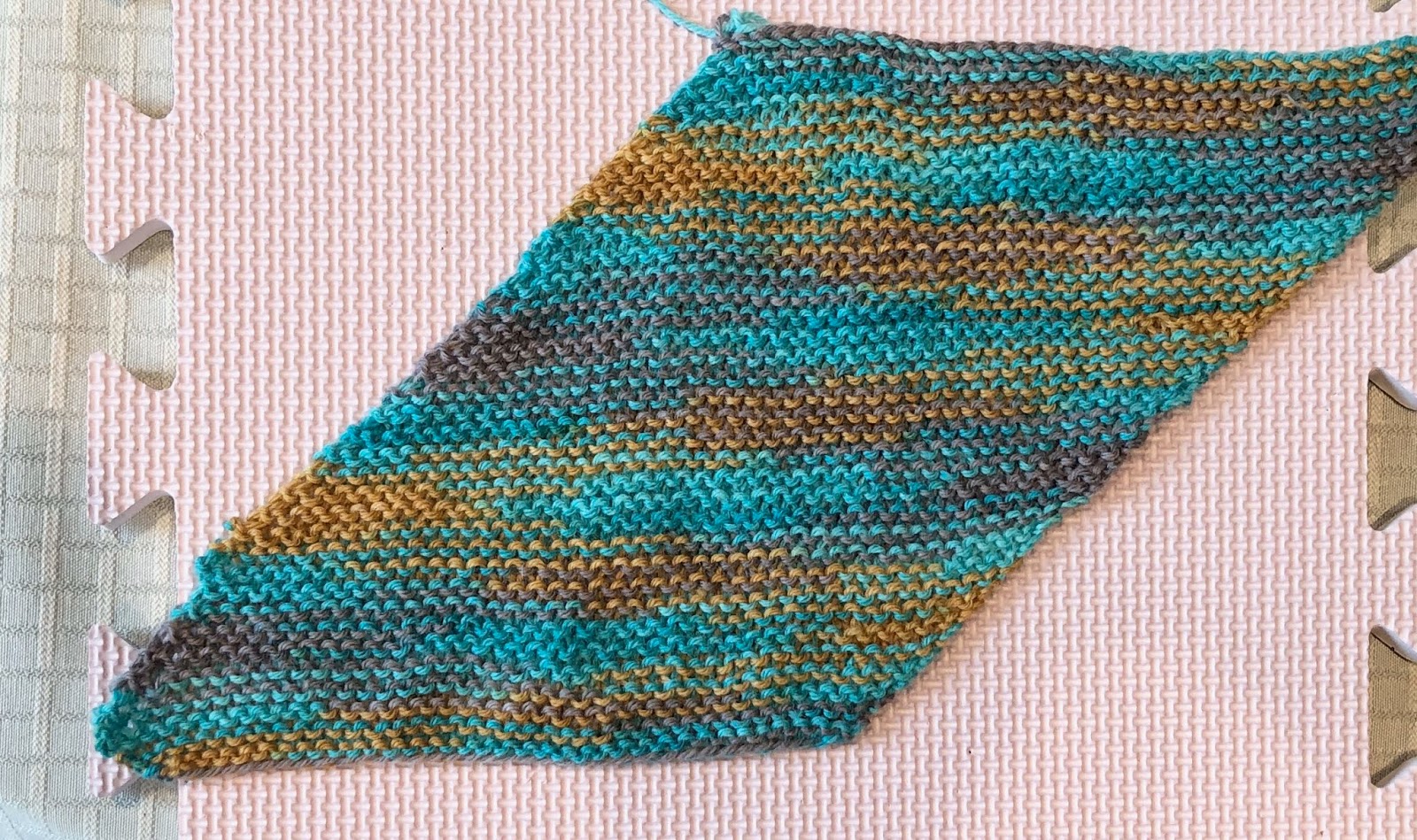
Today we are talking about knitting with a bias.  This just means using increases and decreases to create a diagonal slant to your knitting.  

Creating a bias is actually pretty easy and a lot of fun.  There are a bunch of ways you can achieve the same effect but this is the one I like to use.

Row 1:  Knit to the last stitch, kfb in stitch
Row 2:  Purl to last two stitches, P2tog

kfb - knit in the front of the stitch like normal, do not take the stitch off of the needle, knit in the back of the same stitch, take the stitch off of the needle - 1 increase made
P2tog - Purl two stitches together

Just keep repeating these two rows and it will look like the above picture.  This example slants left but if you reverse the way the increases and decreases are used then you could slant it right by doing this:

Row 1:  Knit to last two stitches, K2tog
Row 2:  Purl to the last stitch, pfb in stitch

K2tog - Knit two stitches together
pfb - purl in the front of the stitch like normal, do not take the stitch off of the needle, purl in the back of the same stitch, take the stitch off of the needle - 1 increase made

Note:  a pfb can be a little tricky.  To purl through the back loop, you need to position your needle so it goes through the back loop from left to right as shown above.
If you didn't like this set up you could do all your increasing and decreasing at the beginning of the rows.  

Regardless, this technique makes a visually interesting diagonal fabric.

Here is a sample that I made with 40 stitches and sock yarn.  It is light and full of drape.

Next week I'm going to share one of my favorite stitch patterns that uses two yarns.


Thanks for reading!


If you have any questions regarding this or any of my other tutorials, please feel free to leave a question in the comments.

Happy crafting!
Ruinwen

😀